Login
Login Register
Taxonomic Hierarchy
- Kingdom: Animalia
- Phylum: Arthropoda
- Class: Arachnida
- Order: Araneae
- Suborder: Araneomorphae
- Family: Trachelidae
- Genus: Trachelas
- Species: Trachelas tranquillus
Other Common Names
Broadfaced Sac Spider, Sac Spider, Bullheaded Sac Spider
Author
Nicholas Marcellus Hentz, 1847
Primary Colors
Sightings Overview
There have been 32 confirmed sightings of Trachelas tranquillus (Broad-faced Sac Spider), with the most recent sighting submitted on November 21, 2023 by Spider ID member bridget-hulsizer. The detailed statistics below may not utilize the complete dataset of 32 sightings because of certain Trachelas tranquillus sightings reporting incomplete data.
- Web: 6% of the time, Trachelas tranquillus spiders are sighted in a spider web (Sample size: 32)
- Sex: 0 female and 0 male.
- Environment: Trachelas tranquillus has been sighted 7 times outdoors, and 25 times indoors.
- Outdoors: Man-made structure (4). Low foliage (3).
Location and Range
Trachelas tranquillus (Broad-faced Sac Spider) has been sighted in the following countries: United States.
Trachelas tranquillus has also been sighted in the following states: Connecticut, Florida, Illinois, Indiana, Kansas, Louisiana, Michigan, Missouri, New Hampshire, New Jersey, New York, Ohio, Pennsylvania, Rhode Island, Virginia, Washington, D.C..
Seasonality
Trachelas tranquillus has been primarily sighted during the month of October.
- January: 1
- February:
- March:
- April:
- May:
- June:
- July:
- August:
- September: 10
- October: 16
- November: 4
- December: 1
Additional Remarks
- Often found in silken retreats constructed in rolled-up leaves or occasionally under rocks.
- Frequently strays indoors in late summer or fall during their mating season.
- Egg sac is white and lenticular, around 10mm in diameter and 2.5mm thick, with around 30-50 eggs; often deposited under loose tree bark, rolled leaves, or under a rock.
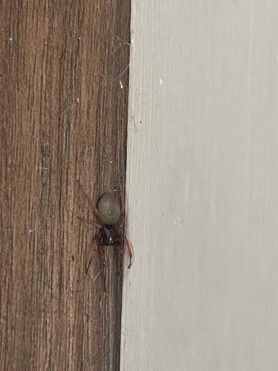
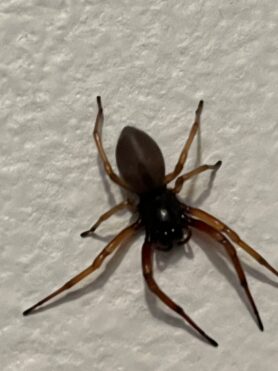
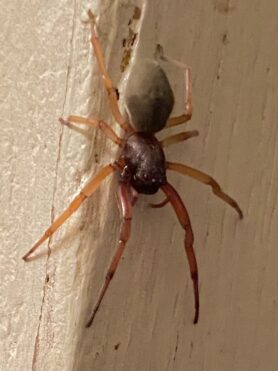
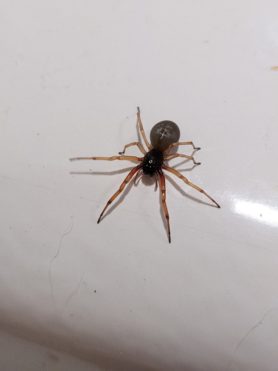
- Because of similar coloration, this species can be mistaken for the “Woodlouse Hunter,” Dysdera crocata. The Woodlouse Hunter can be distinguished by its very long jaws and fangs, as well as its unique eye arrangement: 6 eyes grouped closely in a semi-circle. Trachelas tranquillus has 8 eyes widely spaced.
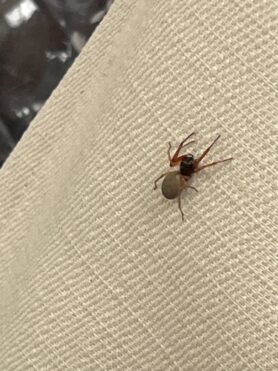

 Nov 21, 2023
 Nov 21, 2023
 OilCity,