Login
Login Register
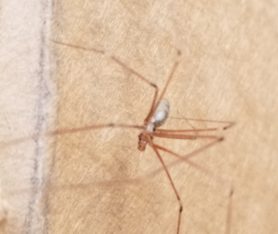
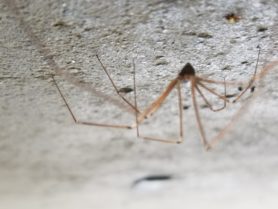
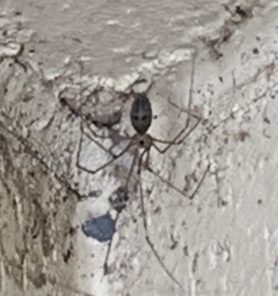
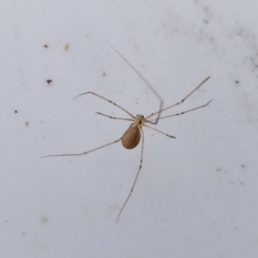
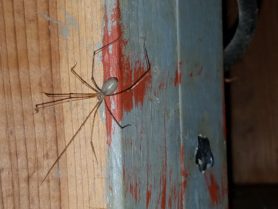 The spider species Pholcus phalangioides, commonly known as Long-bodied Cellar Spider, belongs to the genus Pholcus, in the family Pholcidae. Pholcus phalangioides spiders have been sighted
 Taxonomic Hierarchy
- Kingdom: Animalia
- Phylum: Arthropoda
- Class: Arachnida
- Order: Araneae
- Suborder: Araneomorphae
- Family: Pholcidae
- Genus: Pholcus
- Species: Pholcus phalangioides
Common Name (AAS )
)
Long-bodied Cellar Spider
Other Common Names
Daddy Longlegs, Cellar Spider, Granddaddy Longlegs, Vibrating Spider
Author
Johann Kaspar Füssli, 1775
Primary Colors
Sightings Overview
There have been 38 confirmed sightings of Pholcus phalangioides (Long-bodied Cellar Spider), with the most recent sighting submitted on October 21, 2023 by Spider ID member erniemas. The detailed statistics below may not utilize the complete dataset of 38 sightings because of certain Pholcus phalangioides sightings reporting incomplete data.
- Web: 39% of the time, Pholcus phalangioides spiders are sighted in a spider web (Sample size: 38)
- Sex: 5 female and 5 male.
- Environment: Pholcus phalangioides has been sighted 6 times outdoors, and 32 times indoors.
- Outdoors: Man-made structure (6).
Location and Range
Pholcus phalangioides (Long-bodied Cellar Spider) has been sighted in the following countries: Canada, South Africa, Spain, United Kingdom, United States.
Pholcus phalangioides has also been sighted in the following states: Alabama, Arkansas, California, Louisiana, Maine, Maryland, Massachusetts, Missouri, New Hampshire, New York, North Carolina, Ohio, Oregon, Pennsylvania, Texas, Washington, Wisconsin.
Seasonality
Pholcus phalangioides has been primarily sighted during the month of March.
- January: 3
- February: 4
- March: 9
- April: 9
- May: 4
- June: 2
- July: 1
- August: 1
- September:
- October: 3
- November:
- December: 2
Additional Remarks
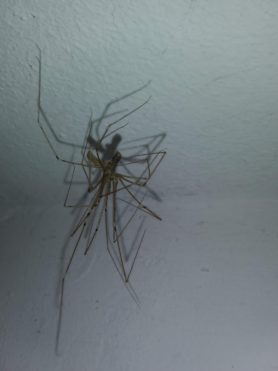
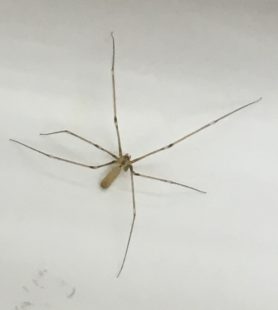
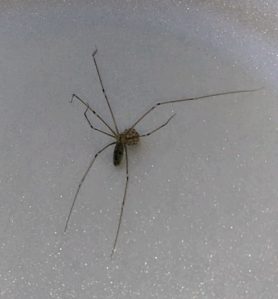
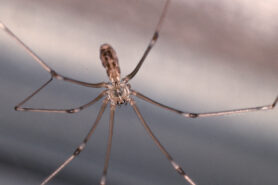
- Legs are very, very long and thin; delicate-looking. They are grayish-brown with bands of white and black at the joints. Front legs on an adult can be up to 50 mm (~2″) in length, sometimes more.
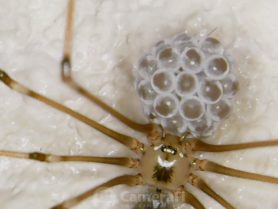
- Eggs are usually visible through the translucent abdominal cuticle of the gravid (pregnant) females.
- May invade the web of other spiders and eat them, including members of their own species. Can also catch and eat other large spiders that walk into their web, including things like the “hobo spider,” the “giant house spider,” and even large “wolf spiders.”
- Females wrap their eggs in a few strands of silk and carry them in their chelicerae (jaws); they may lay up to three egg sacs in her lifetime, each one about 30 eggs.
- Mother doesn’t usually feed at all while she holds the eggs in her mouth, however they’re occasionally witnessed hanging their egg sac in the web temporarily in order to feed, preen, or mate (Eiseman & Charney 2010).
- Spider may quickly “bounce” up and down in their web if feeling threatened. This is where the (not often used) nickname “vibrating spider” comes from.
- There is a persistent rumor that this spider (or others in the same family) has the most potent venom of all spiders, but there’s never been a single shred of scientific evidence to back this up. Arachnologists think their venom is not very potent at all, even when used on insects.
- The common name “daddy longlegs” has/is also used for harvestmen (which are arachnids, but aren’t spiders) and some crane flies (flying insects not related to spiders).

 Oct 21, 2023
 Oct 11, 2023
 Milwaukee,